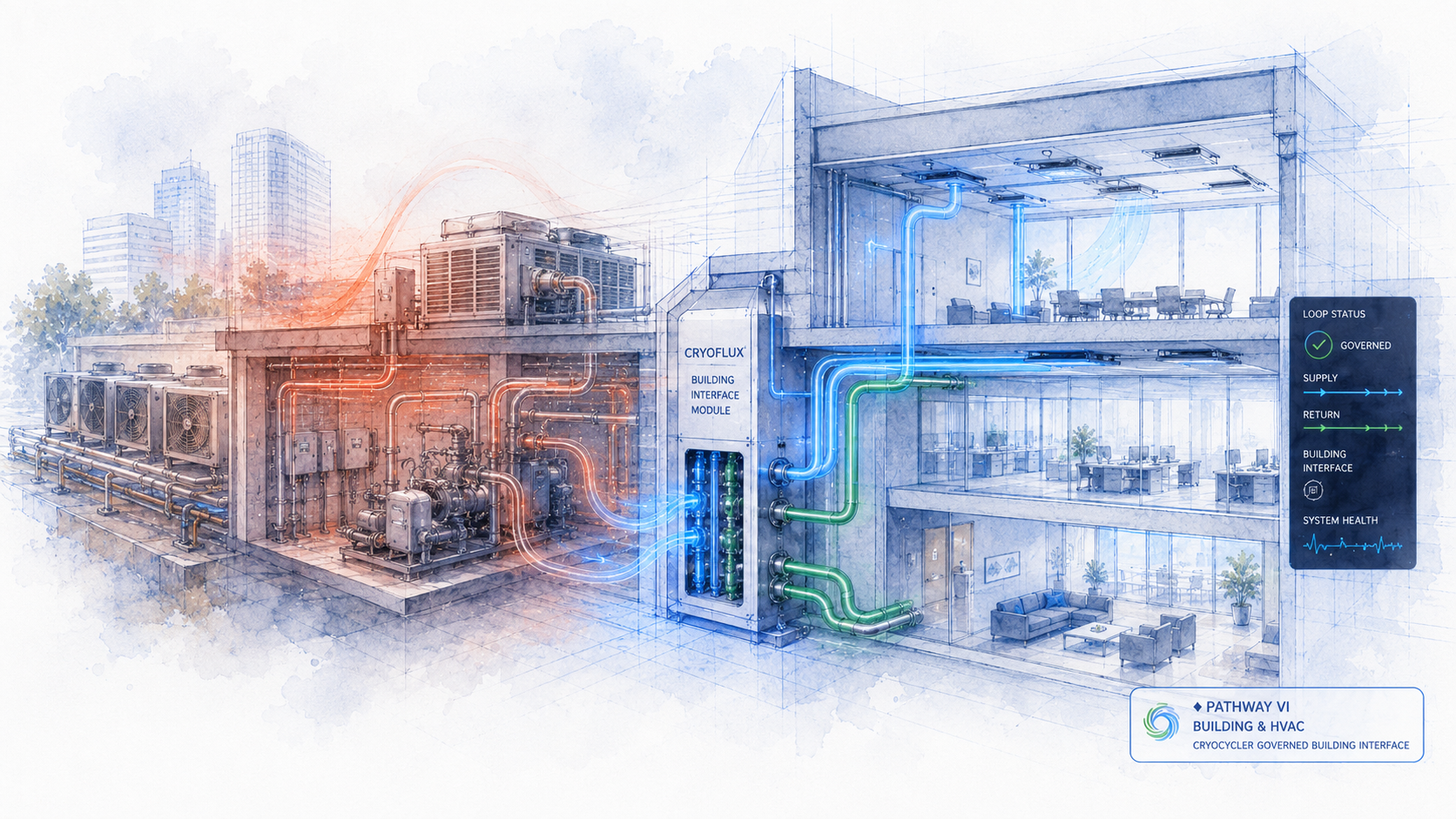
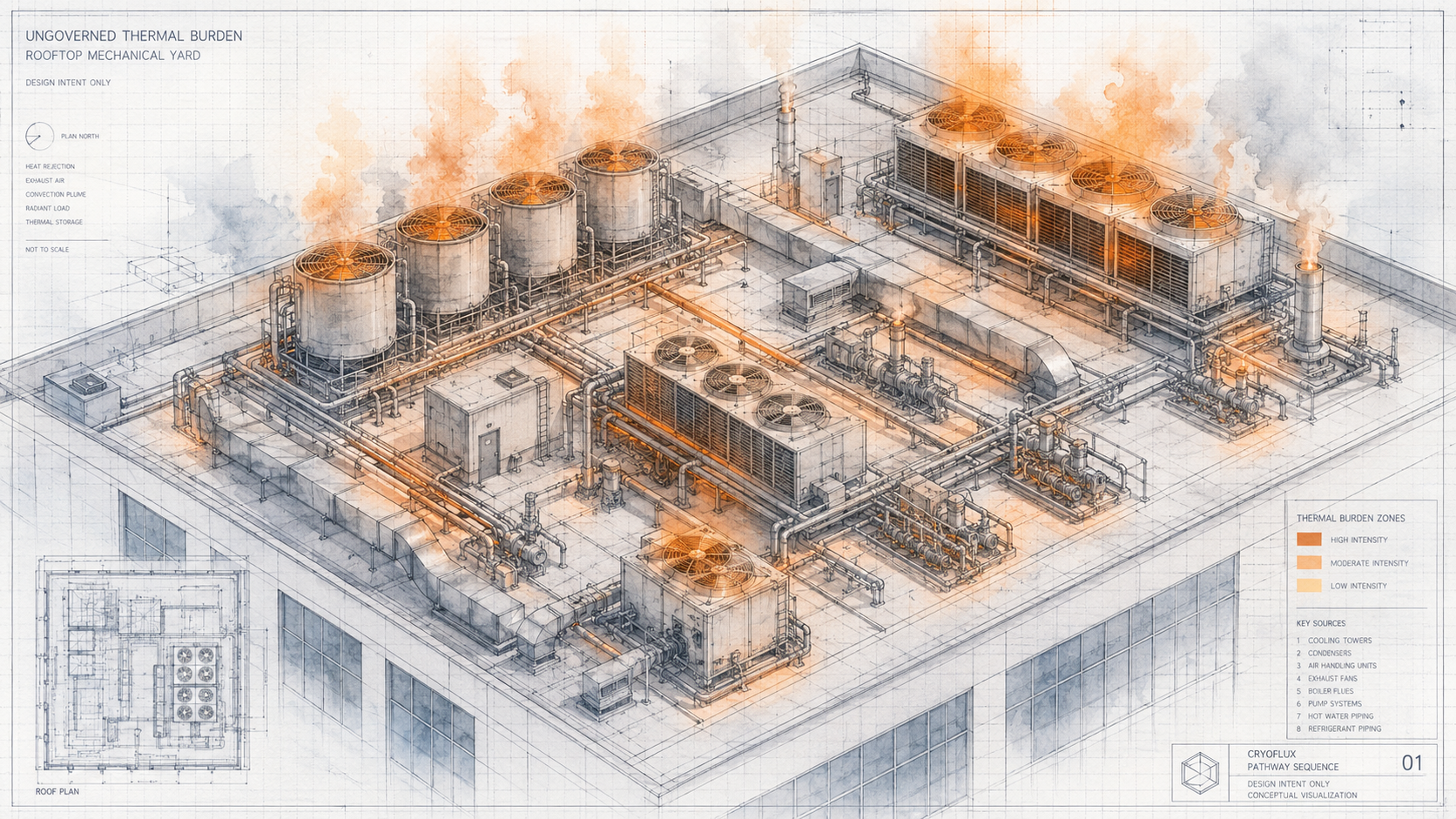
Commercial buildings concentrate mechanical infrastructure on the rooftop -- cooling towers, condensers, air handling units, exhaust fans, boiler flues, and pump systems. Each piece of equipment generates thermal burden that the building's HVAC infrastructure was designed to reject, not govern. The result is continuous energy expenditure against a thermal field that grows with occupancy and equipment density.
| Rooftop Thermal Burden | Representative Anchor |
|---|---|
| Commercial HVAC energy consumption | HVAC accounts for approximately 40% of commercial building energy use in the U.S. |
| Cooling tower water consumption | A mid-size commercial building cooling tower can consume 1 to 3 million gallons of water annually |
| Rooftop equipment heat rejection | Heat rejection occurs after thermal burden has propagated through the building -- not at the source |
| Peak demand window | HVAC systems are sized for peak load -- running at partial capacity 80-90% of operating hours at higher unit cost |
Sources: U.S. Energy Information Administration -- Commercial Buildings Energy Consumption Survey; ASHRAE -- Building Energy Standards.
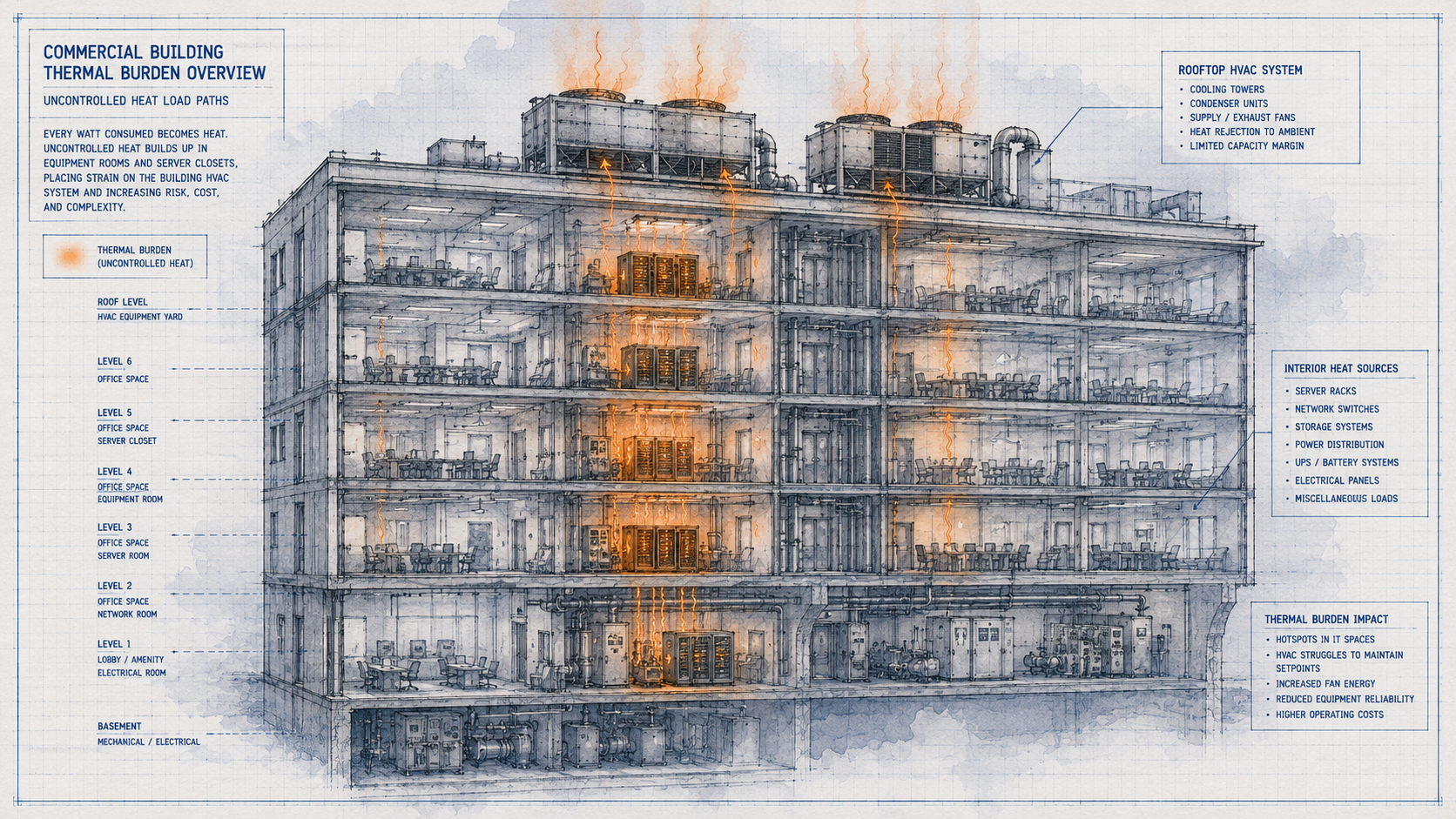
Every floor carries thermal burden the building's distributed cooling infrastructure was not sized to handle. Server closets, telecom rooms, UPS systems, and equipment rooms generate concentrated heat loads inside the occupied space -- not on the mechanical yard where cooling capacity exists. The corridor outside is comfortable. The hotspot inside the server room remains ungoverned.
| Interior Thermal Burden | Representative Anchor |
|---|---|
| Server room heat density | Small server closets can generate 5 to 20 kW of heat in as little as 50 square feet -- far exceeding what ambient HVAC can address |
| Equipment room thermal cycling | Temperature fluctuations above recommended operating ranges accelerate component degradation and reduce equipment life |
| Downtime risk | Thermal events are among the leading causes of unplanned downtime in commercial building IT and telecom infrastructure |
| Relationship to HVAC capacity | Distributed HVAC systems are designed for space conditioning -- not for point-source thermal burden management at the equipment level |
Sources: ASHRAE -- Data Center Design and Operations; Uptime Institute Annual Outage Analysis.
CryoFlux does not claim specific energy reduction percentages or equipment life extension guarantees. CryoFlux targets the architectural shift from ambient space conditioning to governed point-source cold delivery -- encircling the burden at its origin rather than managing the thermal aftermath. Performance specifications will be reported from pilot program data.
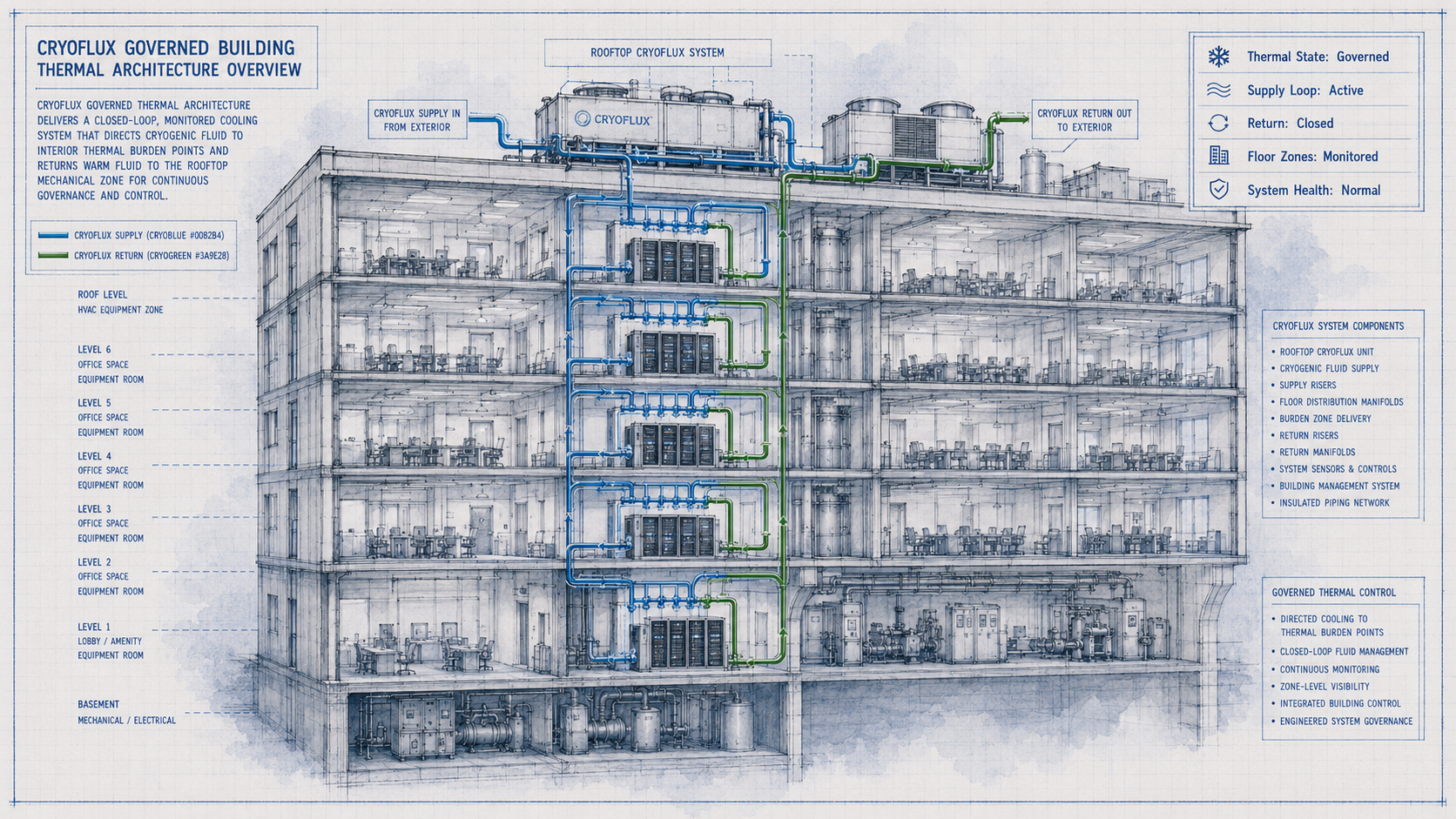
CryoFlux maps the thermal burden field across the building -- rooftop mechanical yard, server floor zones, equipment rooms. Each is a governed cold-path target with its own delivery architecture. The supply path enters the building exterior, branches to the rooftop zone, and drops through the interior to each burden floor. At every site, the cold encircles the burden in a closed regenerative loop.
| CryoFlux Building Architecture -- Design Target | Intended Commercial Meaning |
|---|---|
| Point-source cold delivery | Cold delivered directly to the thermal burden source -- rooftop equipment and interior hotspots -- not distributed through the conditioned space |
| Closed regenerative loop | Phase change activity captured and returned at each floor zone -- reducing continuous supply dependency |
| Multi-zone floor coverage | Single supply architecture branches to rooftop and drops through interior -- same governed cold platform across all burden zones |
| Continuous telemetry | Temperature, loop health, zone status, and return state monitored throughout the building -- anomalies detectable in real time |
| HVAC coexistence | CryoFlux governs the burden source. The building's existing HVAC continues to condition the occupied space. No replacement -- augmentation at the source. |
| No efficiency percentage claims | CryoFlux targets the architectural shift from ambient rejection to governed source delivery. Performance data will be reported from pilot programs. |
The CryoCycler loop governs the cold-domain energy state of the building thermal architecture -- delivering governed LN2 to rooftop and interior burden zones, capturing the phase change return, and renewing the cold for continued delivery rather than discarding it as thermal waste.
CryoVacuLock / CryoVestibule architecture maintains the atmospheric boundary at each governed cold-delivery zone -- controlling moisture ingress, preventing condensation events at the thermal interface, and sustaining the pressure conditions that protect the governed cold environment.
CTD geometry at the thermal interface governs the cold delivery contact architecture at the point of burden -- ensuring governed cold reaches the thermal burden source at the rooftop equipment or interior hotspot, not the ambient space around it.
| Category | Conventional Building HVAC | CryoFlux Building Thermal Governance |
|---|---|---|
| Thermal control point | Ambient space conditioning -- thermal burden managed after it escapes the equipment and enters the occupied space | Point-source cold delivery -- governed cold delivered directly to the burden source before propagation to the space |
| Interior hotspot coverage | Server closets and equipment rooms receive the same ambient air as the surrounding corridor -- hotspot persists | Each floor burden zone receives its own governed cold-path delivery -- hotspot addressed at origin |
| Energy architecture | HVAC sized for peak load -- operating at partial capacity and higher unit cost during non-peak hours | Governed cold delivered only where burden exists -- supply architecture maps to actual thermal field |
| Return and recovery | Heat rejected to atmosphere via cooling towers or condensers -- no recovery of thermal energy | Closed regenerative loop -- phase change activity captured and returned at each zone |
| Telemetry | Typically zone-level temperature sensing only -- equipment condition monitored after thermal events occur | Continuous loop health, zone status, and return state monitoring -- anomalies detectable in real time |
| Claim posture | Conventional HVAC: ambient space conditioning, passive thermal rejection, no point-source governance | CryoFlux design intent: governed source delivery and closed-loop recovery. No efficiency percentage claim. No replacement claim. |
Conventional HVAC limits equipment density because interior hotspots cannot be addressed by ambient air distribution. Governed point-source cold delivery targets the removal of the thermal ceiling on interior equipment density -- allowing building operators to deploy more compute and telecom infrastructure per floor without thermal compromise.
Cooling towers consume significant water volume annually and create ongoing maintenance, water treatment, and regulatory compliance burdens. CryoFlux targets a closed-loop cold delivery architecture that reduces the thermal load delivered to rooftop cooling towers -- reducing the water consumption and infrastructure exposure that conventional rejection creates.
Thermal events in server closets and equipment rooms are among the leading causes of unplanned building infrastructure downtime. Continuous telemetry and governed cold delivery target anomaly detection and thermal state maintenance before equipment-level thermal events propagate to operational disruption. Design intent only -- performance data from pilot programs.
Governed cold delivered to the source -- rooftop mechanical yard, server floor zones, and equipment rooms -- floor by floor, loop by loop.