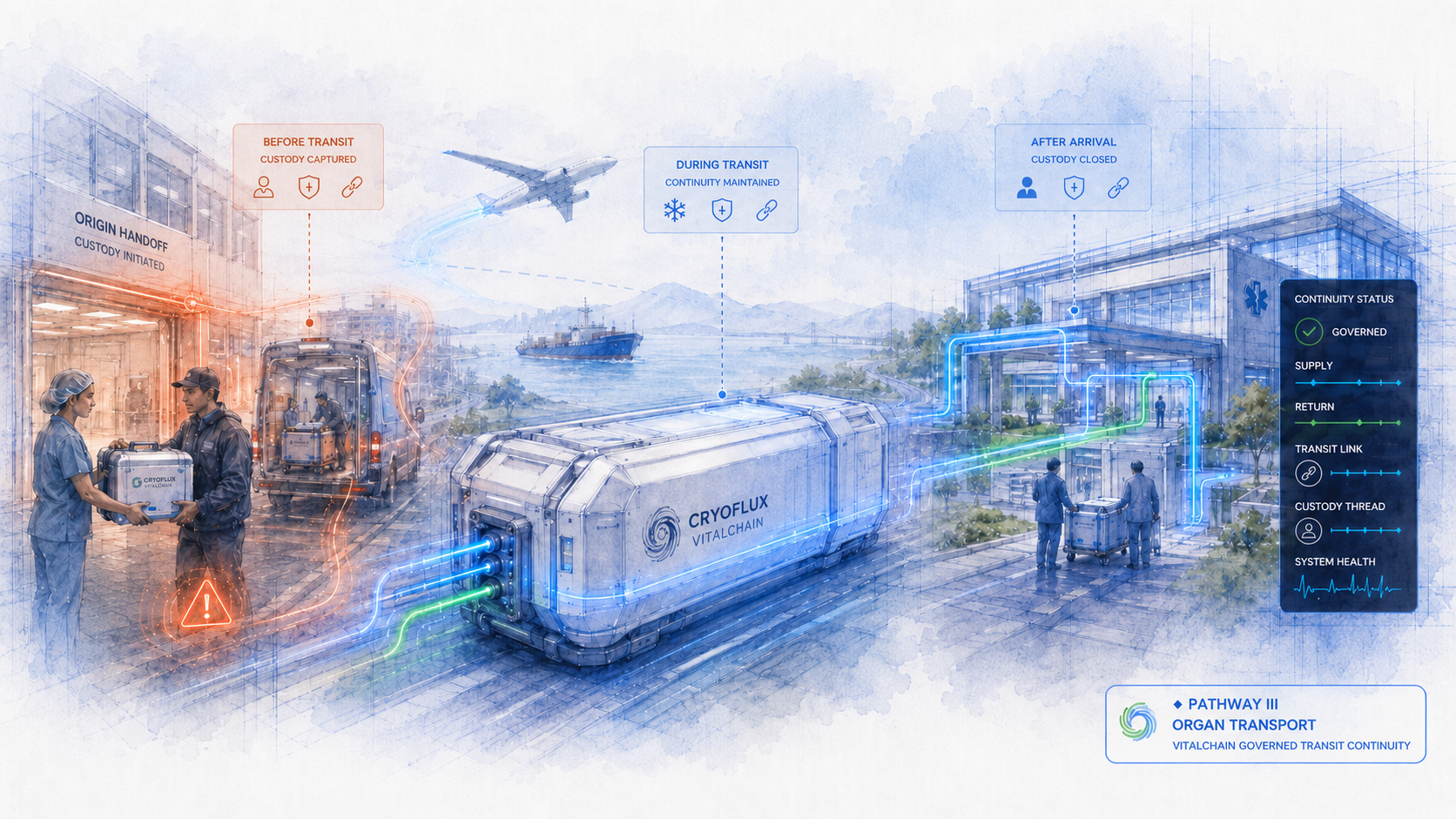
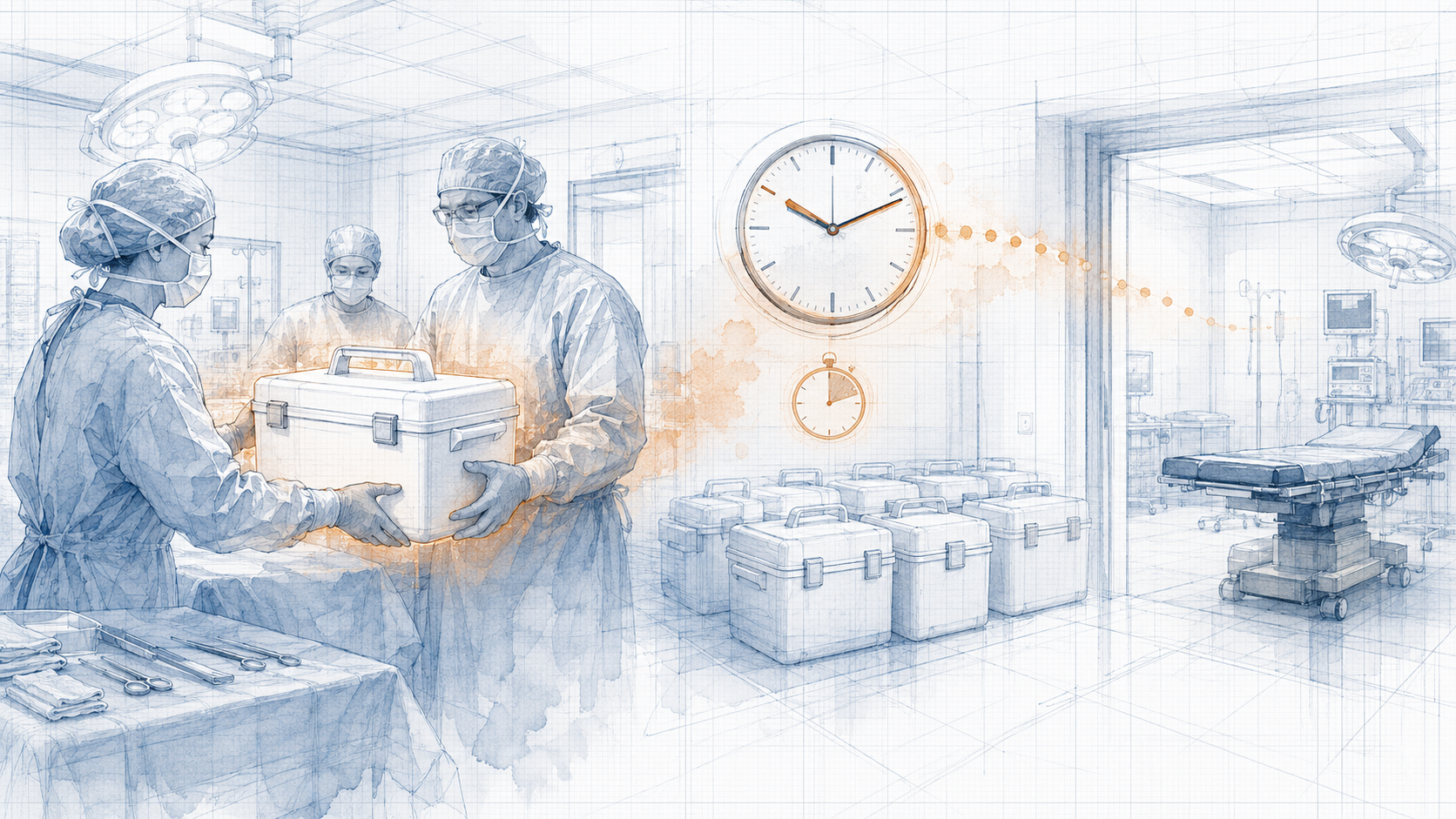
Nearly 100,000 patients are on the U.S. kidney transplant waitlist. An average of 34 are removed daily -- not because transplants were performed, but because they died or became too sick. An average of 3,280 recovered deceased donor kidneys are discarded annually -- organs that were procured but never transplanted.
| Organ Transport Burden | Representative Anchor |
|---|---|
| Patients on U.S. kidney transplant waitlist | Nearly 100,000 |
| Patients removed from waitlist daily | Average 34 per day -- died or became too sick to receive transplant |
| Recovered deceased donor kidneys discarded annually (U.S.) | Average 3,280 per year |
| Relationship to cold ischemia time | Increased cold ischemia time is associated with increased organ decline and subsequent discard |
Sources: NIH / SNAP Assessment Study, 2025; Kidney Medicine / UCLA, 2022 (OPTN/UNOS database).
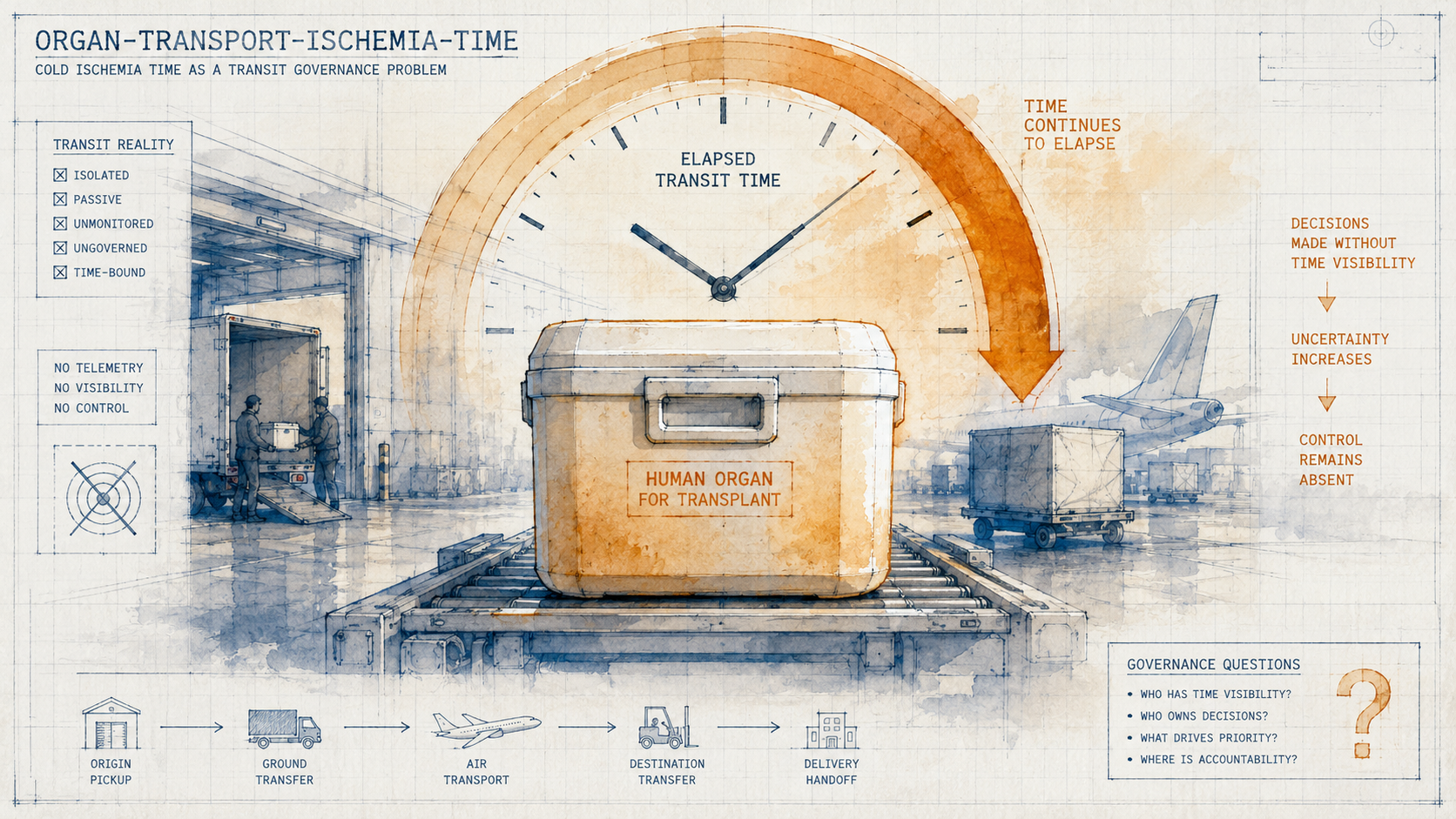
Cold ischemia time is the interval an organ spends outside the body under cold preservation before implantation. As cold ischemia time increases, the rate of delayed graft function rises measurably. Every hour of transit is a governed cold continuity problem.
| Cold Ischemia Time -- Delayed Graft Function Rate | Published Rate |
|---|---|
| Under 16 hours | 20.9% delayed graft function rate |
| 16 to 24 hours | 28.1% delayed graft function rate |
| 24 to 32 hours | 32.4% delayed graft function rate |
| 32 to 40 hours | 37.5% delayed graft function rate |
Source: Kidney Medicine / UCLA, 2022 -- retrospective cohort, OPTN/UNOS database 2000-2018.
CryoFlux does not claim to extend organ viability or improve transplant outcomes. CryoFlux governs the cold chain continuity and custody accountability architecture that supports the clinical team's work -- ensuring the thermal state is maintained and documented from origin handoff to arrival.
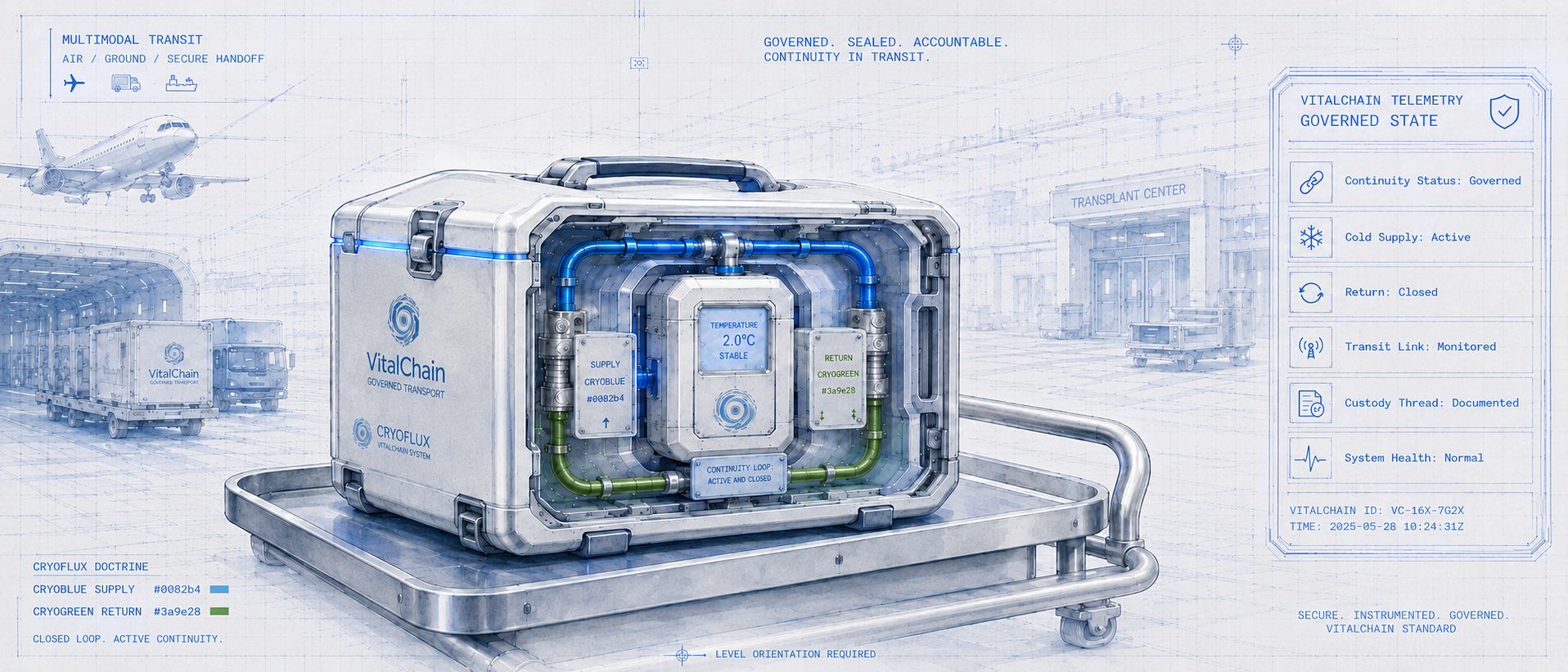
VitalChain is CryoFlux's governed transit continuity architecture for biological cargo. It governs the cold domain of the transport vessel, monitors the custody chain, and documents the thermal state from handoff to arrival -- providing the clinical team with a governed, accountable, instrumented transport record.
| VitalChain Design Target | Intended Commercial Meaning |
|---|---|
| Governed cold domain during transit | Active thermal state maintained throughout the transport envelope -- not passive ice or static coolant |
| Continuous custody documentation | Every handoff, every transit stage, every custody transfer documented in real time -- accountable chain of custody |
| Telemetry throughout transit | Temperature, pressure, loop health, and transit link monitored continuously and reportable to the receiving clinical team |
| Multi-modal transit architecture | Ground, air, and sea transit segments governed under the same cold continuity architecture |
| No viability or outcome claims | VitalChain governs the transport environment. Clinical viability and transplant outcomes are the domain of the clinical team and receiving institution. |
The CryoCycler loop governs the cold-domain energy state of the VitalChain transport vessel throughout transit -- delivering the thermal condition, capturing the return, and sustaining the governed cold environment across every transit stage.
CryoVacuLock / CryoVestibule architecture maintains the atmospheric boundary of the transport enclosure -- preventing ambient intrusion, controlling moisture, and sustaining the pressure conditions that protect the biological cargo environment.
VitalChain custody thread documents every handoff, every transit stage, and every custody transfer in real time -- providing the receiving clinical team with a complete, verifiable record of the thermal and custody state throughout transport.
| Category | Conventional Organ Transport | VitalChain Governed Transit Continuity |
|---|---|---|
| Cold-state maintenance | Static ice or passive coolant -- no active loop, no continuous thermal monitoring | Active governed cold loop -- thermal state maintained and monitored throughout transit |
| Custody documentation | Manual chain-of-custody forms; documentation gaps possible between handoff stages | Continuous digital custody thread -- every stage, every handoff, every transfer documented in real time |
| Telemetry | Typically none during transit; condition assessed only at origin and arrival | Continuous telemetry: temperature, pressure, loop health, transit link status -- reportable to receiving team |
| Transit risk | Passive cold state degrading over time with no active intervention architecture | Governed cold domain with active loop and monitoring -- anomalies detectable during transit, not only at arrival |
| Claim posture | Conventional transport: passive cold, manual documentation, no continuous monitoring | VitalChain design intent: governed continuity and custody accountability. No viability claim. No transplant outcome claim. |
Passive transport allows the cold state to degrade without intervention. Governed continuous cold delivery targets active maintenance of the thermal state throughout transit -- reducing the gap between procurement and implantation conditions.
Conventional transport relies on manual documentation with inherent gaps at handoff points. VitalChain targets a continuous, digital, verifiable custody record from origin to arrival -- supporting institutional accountability and regulatory compliance.
With an average of 3,280 recovered kidneys discarded annually in the U.S., every improvement in cold-chain governance is a potential reduction in organ waste. VitalChain targets the transport infrastructure as a governed system, not a passive delivery mechanism.
VitalChain governs the cold domain and custody chain so the clinical team receives what was sent.