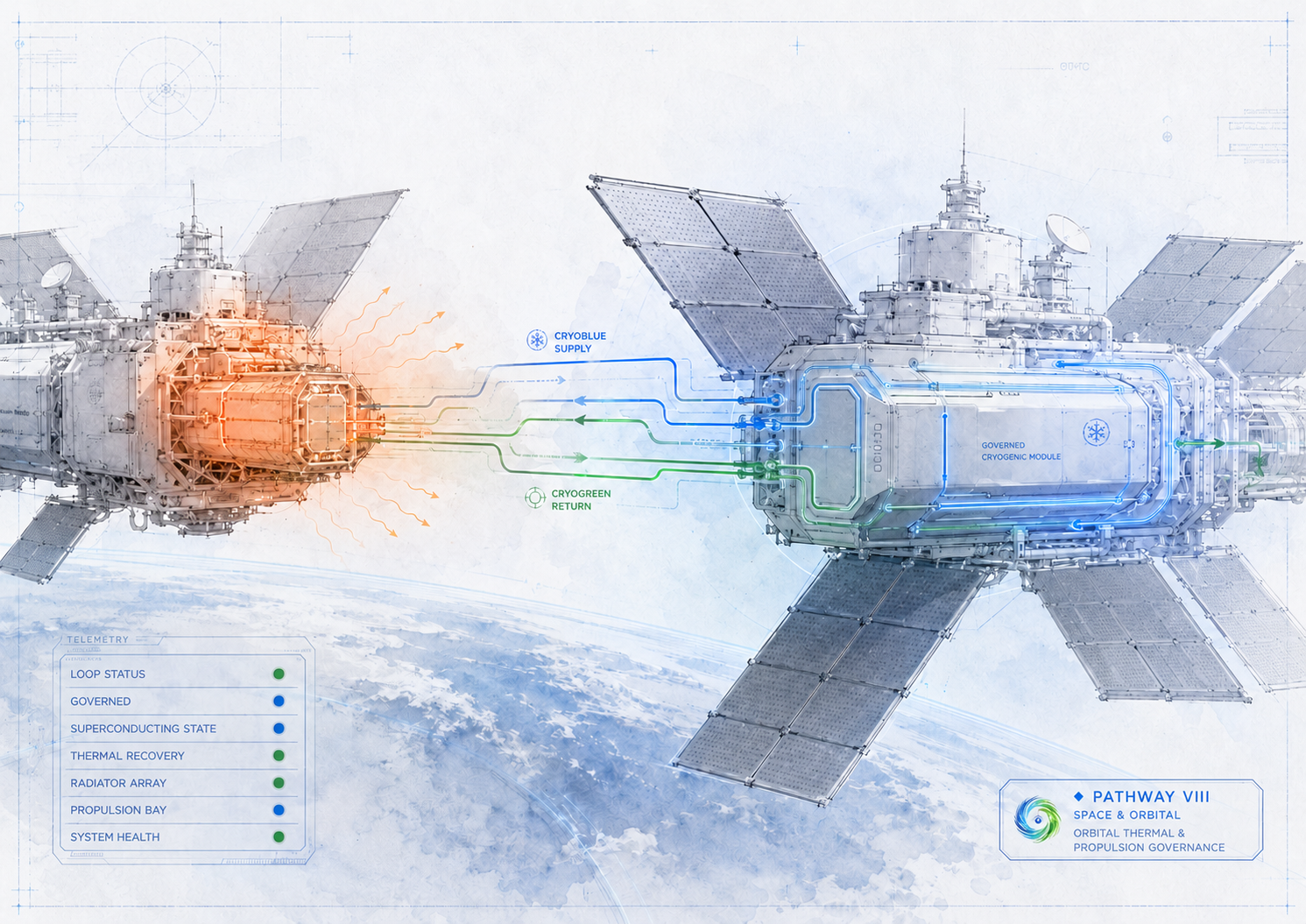
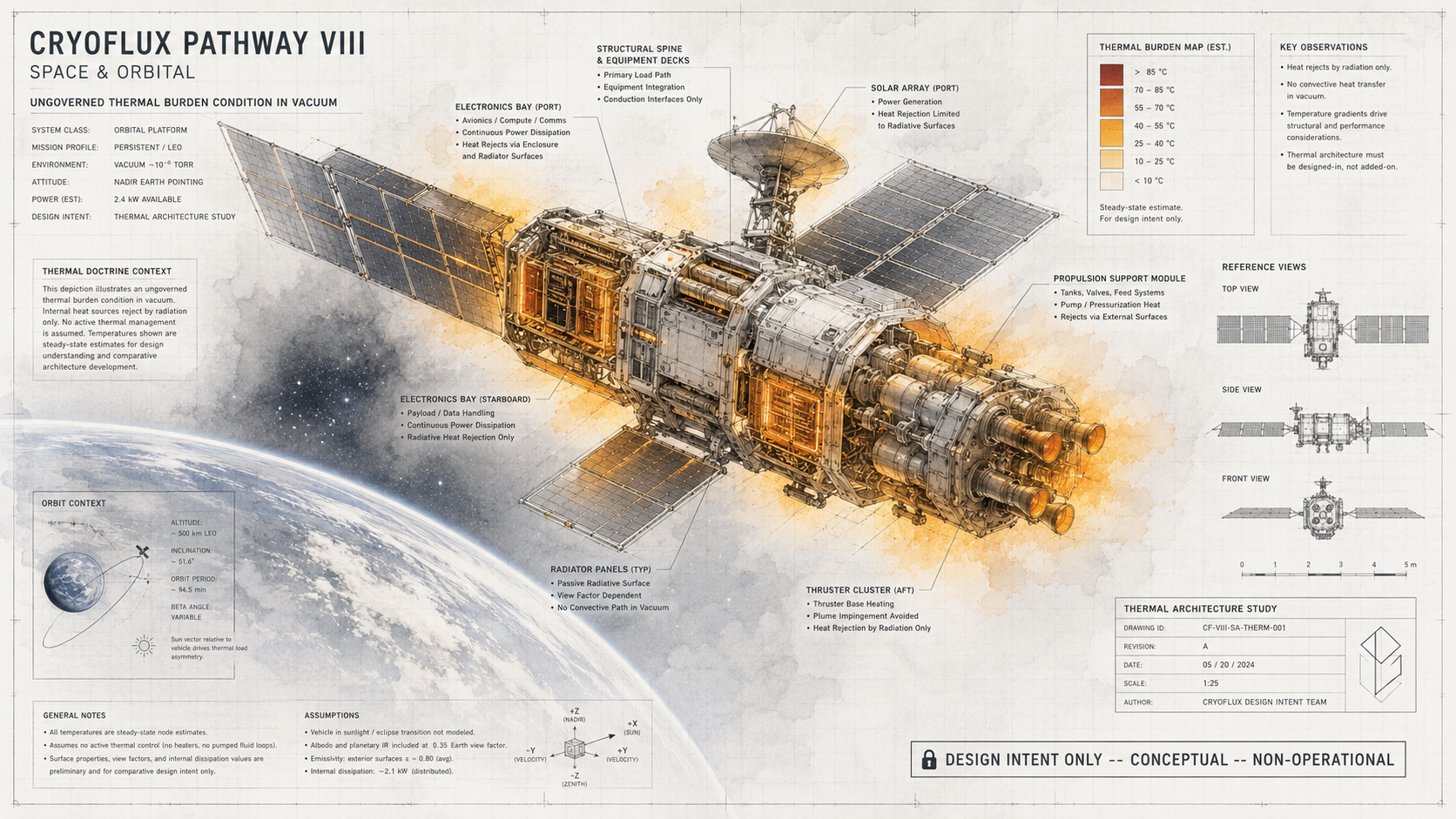
In the vacuum of space, heat cannot be removed by convection. Every watt of waste heat must be actively transported away from the heat source and radiated. The orbital thermal environment imposes simultaneous extremes -- direct solar radiation on sun-facing surfaces and 2.7 K deep space background on shadow-facing surfaces.
| Orbital Thermal Burden | Representative Anchor |
|---|---|
| Deep space background temperature | 2.7 K (-270.45°C) -- the thermal sink available to all radiating surfaces |
| Direct solar radiation at Earth orbit | Approximately 1,367 W/m² on sun-facing surfaces |
| Thermal swing range in vacuum environments | Greater than 300°C between sun-facing and shadow-facing surfaces |
| Lithium-ion battery operating range (spacecraft) | -5°C to 20°C -- narrow range requiring active thermal governance |
| Propulsion component safe temperature range | 5°C to 40°C -- must be maintained throughout mission |
| Heat rejection method in space | Radiation only -- no convection, no conduction to atmosphere |
Sources: Celeroton Space Thermal Management, 2026; Electronics Cooling, 2026; Wikipedia -- Spacecraft Thermal Control.
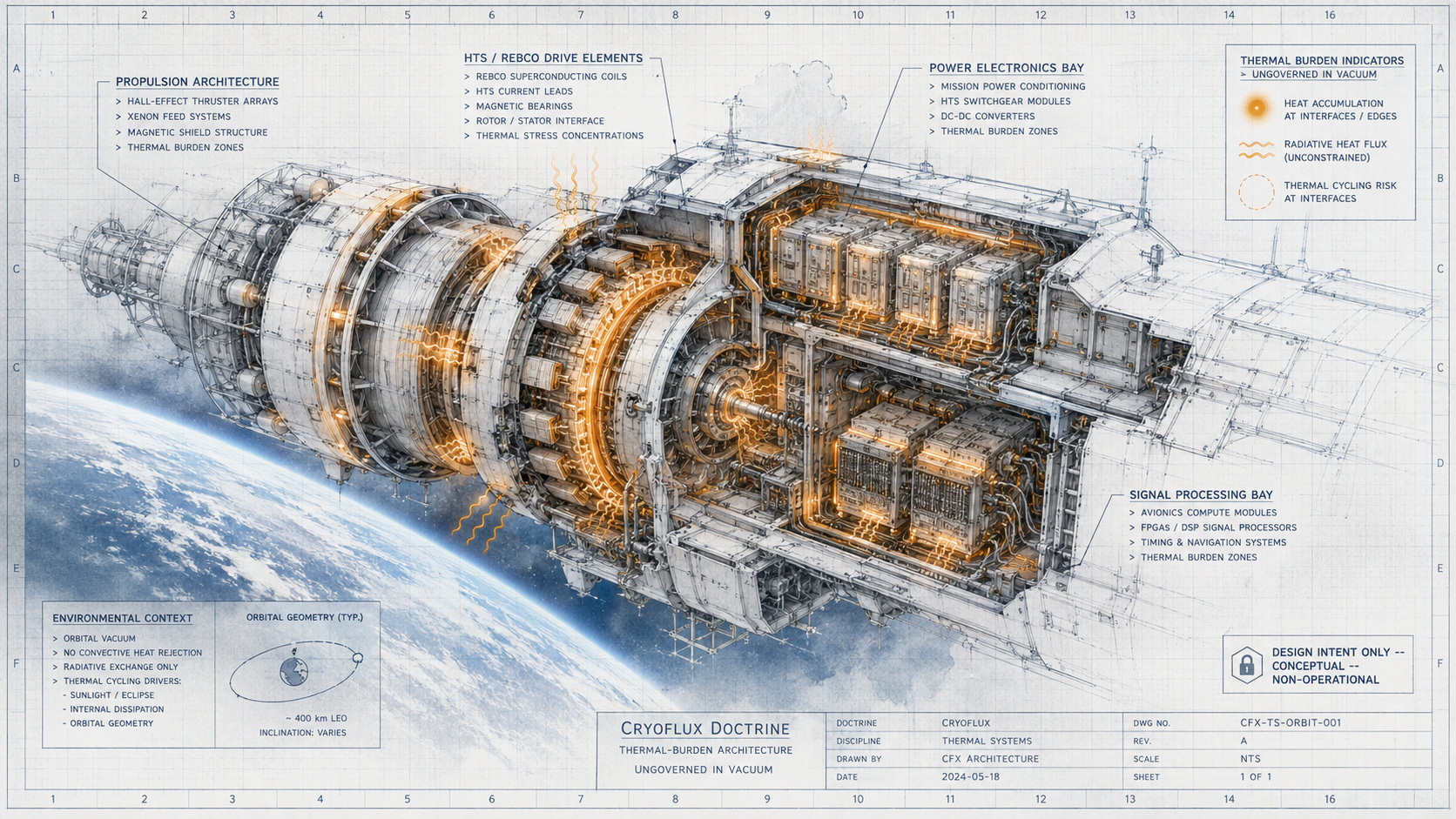
Advanced orbital systems increasingly depend on superconducting components and high-density electronics that require cryogenic operating environments. For future space systems, thermal control is no longer a subsystem. It is an enabling architecture. The governed cryogenic state is the condition on which mission capability depends.
| Orbital System Thermal Demand | Nature of Burden |
|---|---|
| Superconducting system operating requirement | Cryogenic temperatures required continuously -- loss of governed cold state means loss of superconducting capability |
| Thermal cycling risk | Repeated thermal cycling between orbital day and night causes material fatigue and calibration drift in precision instruments |
| Internal heat accumulation | No convective path in vacuum -- all internal electronics heat must be conducted and radiated; accumulation leads to system stress |
| Power budget impact | Thermal management systems compete with mission systems for limited power budget -- ungoverned architecture wastes power on reactive cooling |
| Radiator array dependency | Heat rejection depends on radiator array size, orientation, and conductance -- all requiring active governance for efficiency |
CryoFlux makes no mission-performance claim, no propulsion-efficiency claim, and no specific thermal range claim for any CryoFlux system in space environments. CryoFlux targets governed cryogenic platform architecture for orbital thermal and propulsion environments -- architecture concept only, pending qualification and program partnership.
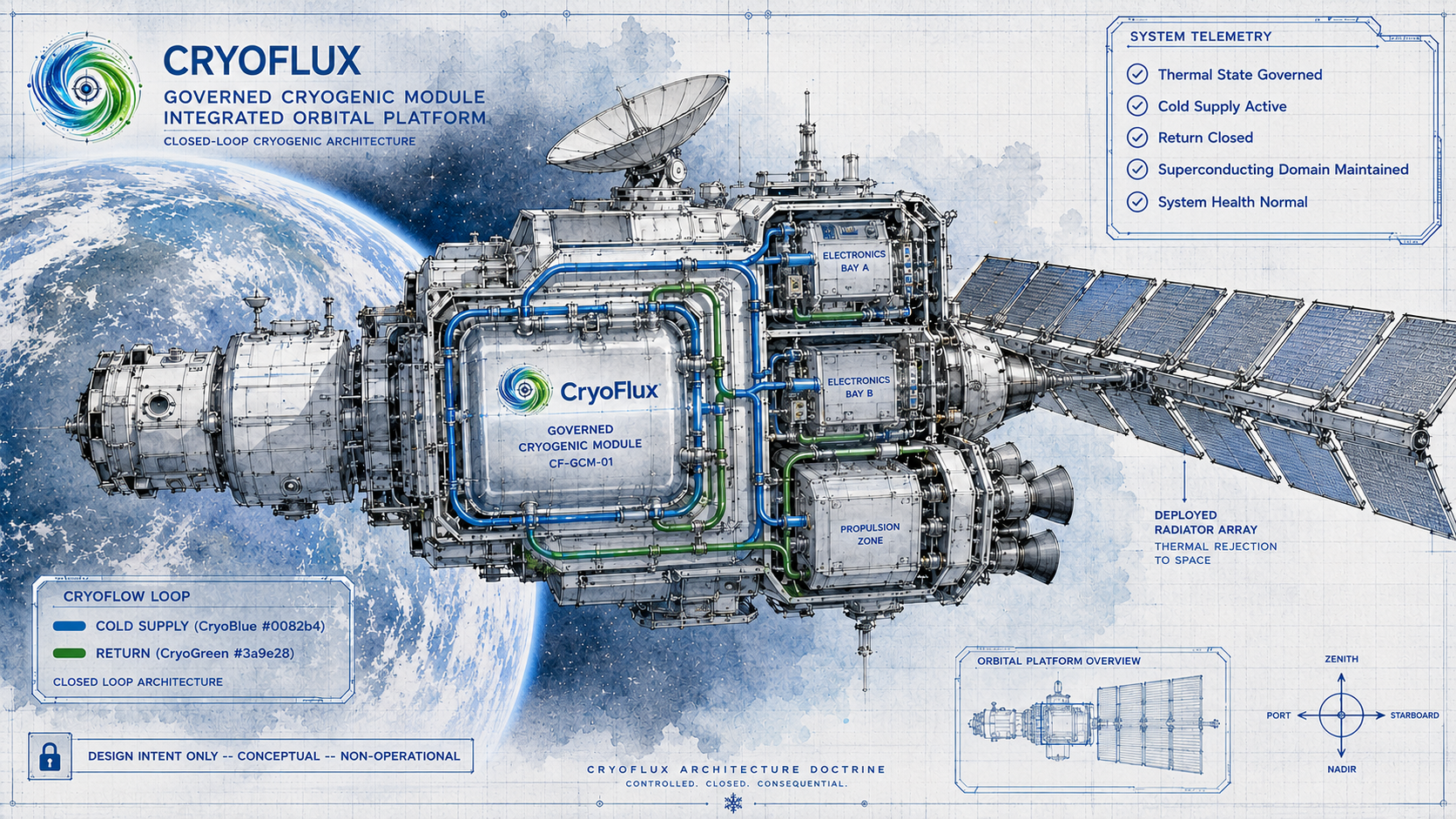
CryoFlux targets orbital thermal and propulsion governance through a governed cryogenic module architecture -- delivering LN2 supply to the propulsion bay and superconducting systems, capturing the warm gas return, and actively managing heat rejection through a governed radiator array. Architecture concept only. Not for flight.
| CryoFlux Orbital Architecture -- Design Target | Intended Mission Architecture Meaning |
|---|---|
| Governed cryogenic supply to propulsion bay | LN2 delivered to superconducting propulsion systems and electronics via radiation-qualified integrated fluidic interface |
| Closed-loop thermal recovery | Warm gas return captured and returned to LN2 governance platform for re-liquefaction and reuse -- reducing expendable cryogen dependency |
| Governed radiator array | Active heat rejection to 2.7 K deep space background via intelligent orientation and conductance control -- not passive fixed-geometry rejection |
| Superconducting state continuity | Governed cryogenic envelope maintains the superconducting operating condition throughout the mission profile |
| Architecture concept status | Not for flight. Not a structural claim. Pending qualification, program partnership, and applicable space agency review. |
The CryoFlex / CryoCycler closed-loop architecture governs the cryogenic energy state of the orbital platform -- delivering LN2 to superconducting systems, capturing the warm gas return, and re-liquefying for reuse rather than venting expendable cryogen.
CryoVacuLock / CryoVestibule architecture governs the sealed cryogenic propulsion bay environment -- maintaining the low-pressure, low-temperature governed envelope that superconducting systems require, isolated from the broader orbital thermal field.
Governed Radiator Array actively manages heat rejection to 2.7 K deep space background through intelligent orientation and conductance control -- replacing passive fixed-geometry radiators with a governed thermal rejection architecture responsive to mission state.
| Category | Conventional Spacecraft Thermal Control | CryoFlux Orbital Thermal Governance |
|---|---|---|
| Thermal control philosophy | Passive and semi-active -- coatings, MLI, heat pipes, fixed radiators designed to balance worst-case conditions | Active governed architecture -- cryogenic supply, closed-loop recovery, governed radiator orientation and conductance |
| Cryogen management | Expendable cryogen stored and vented -- supply decreases over mission lifetime, limiting mission duration | Closed-loop re-liquefaction target -- cryogen captured, recovered, and reused rather than vented |
| Heat rejection | Fixed radiator geometry -- rejection rate dependent on orientation to sun and deep space; not actively governed | Governed radiator array -- active orientation and conductance control targeting maximum rejection to 2.7 K background |
| Superconducting state | Maintained by expendable cryogen with passive insulation; vulnerable to supply depletion and service event cryogen loss | Governed continuous supply and recovery loop targeting sustained superconducting state throughout mission profile |
| Claim posture | Conventional: passive TCS, expendable cryogen, fixed radiator | CryoFlux design intent: governed orbital thermal architecture. Architecture concept only. Not for flight. No mission-performance guarantee. |
Conventional orbital cryogen management treats LN2 as an expendable -- stored, used, and vented. Closed-loop recovery architecture targets significant reduction in expendable cryogen consumption by capturing and re-liquefying the warm gas return -- extending the governed cold state without additional supply.
Superconducting propulsion and instrument systems require uninterrupted cryogenic state. Passive management degrades over mission lifetime as expendable supply decreases. CryoFlux targets continuous governed state persistence through closed-loop supply and recovery rather than passive supply depletion.
Fixed radiators reject heat at rates determined by geometry and orientation -- not by mission demand. Governed radiator array architecture targets active heat rejection responsive to real-time mission thermal state -- maximizing rejection to 2.7 K deep space when and where the mission needs it.
Architecture concept. Partnership inquiries welcome. Not for flight without applicable qualification and program review.