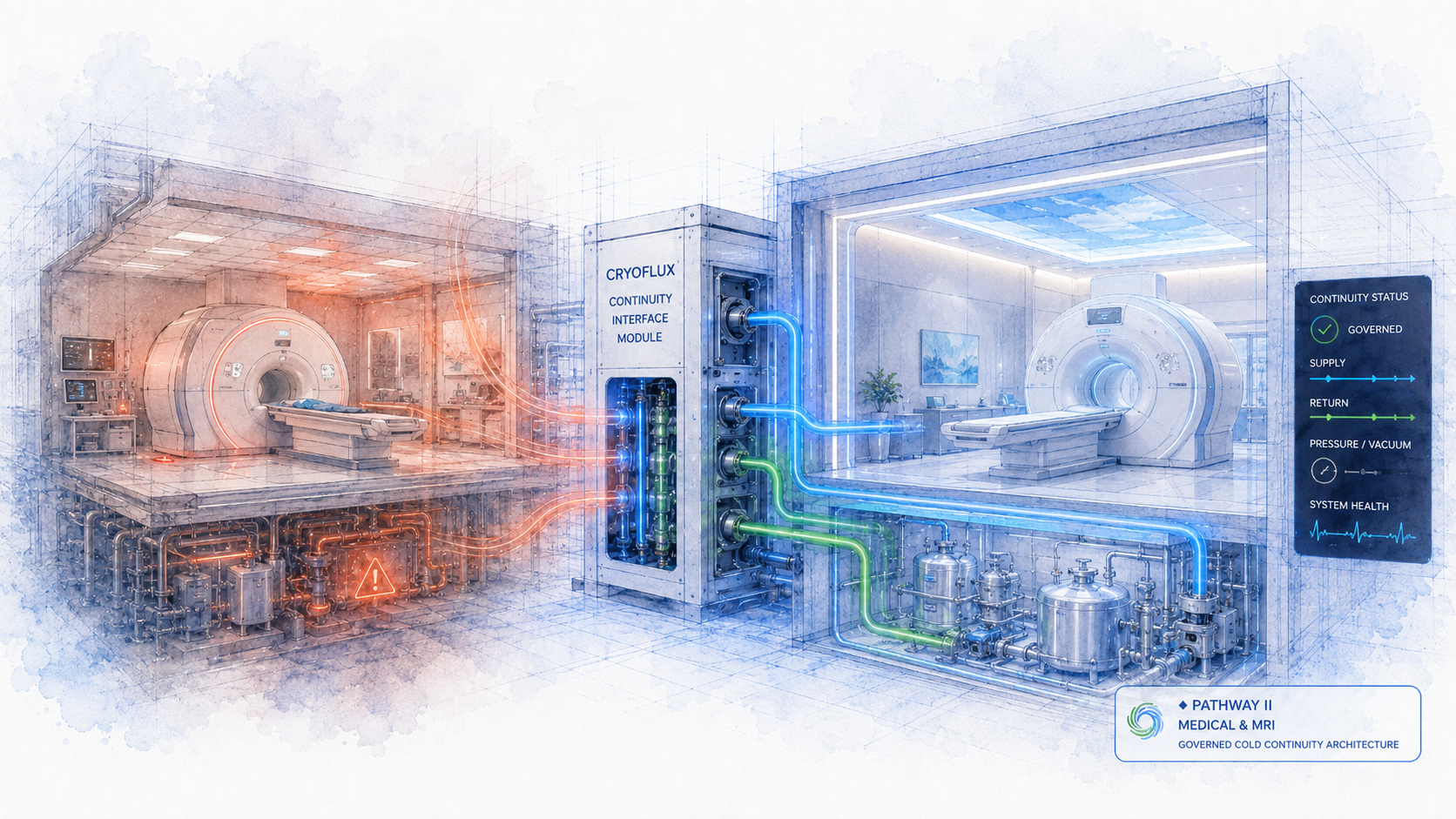
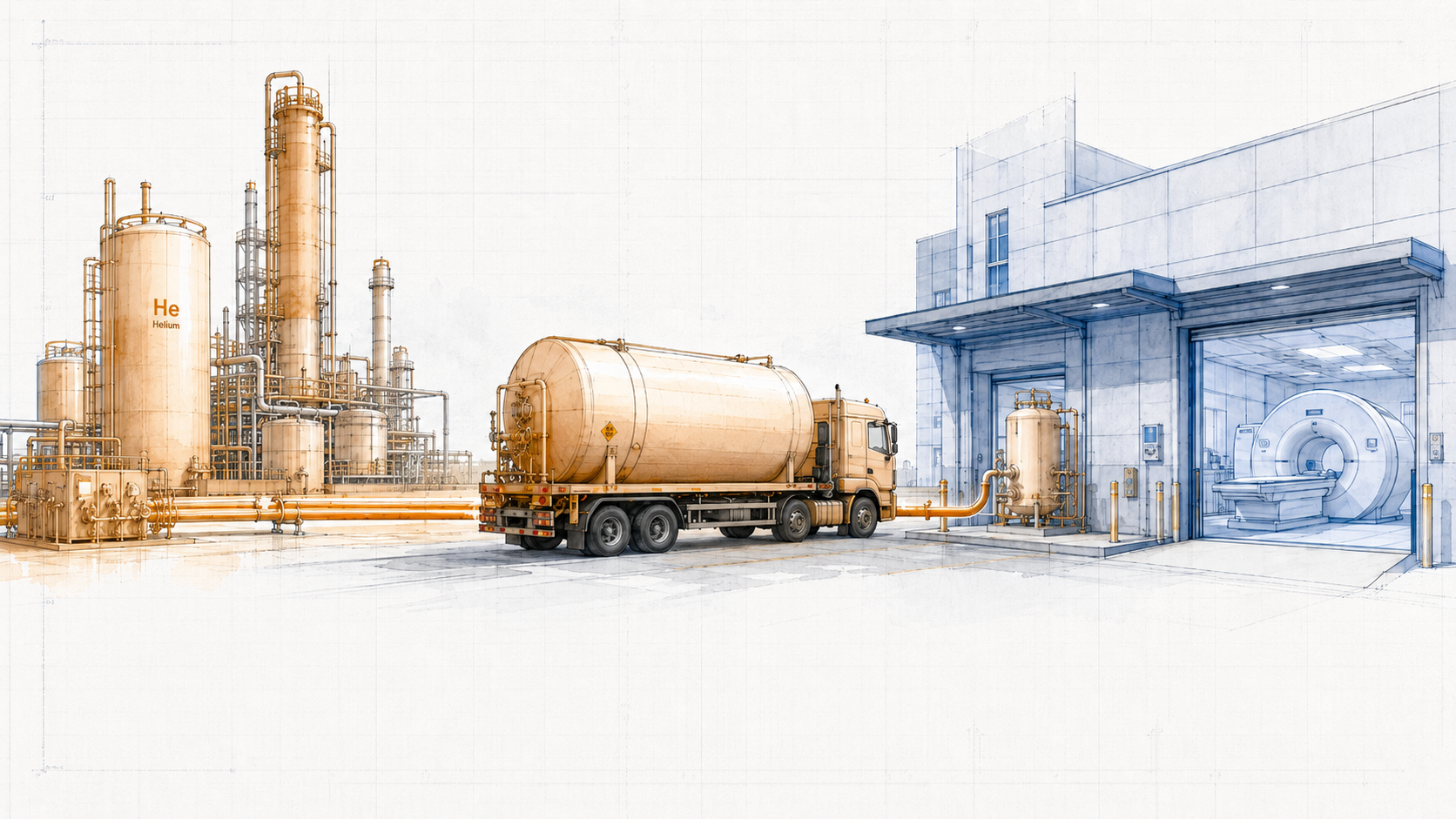
A standard superconducting MRI system requires approximately 1,500 liters of liquid helium to maintain the superconducting state. Helium is a finite, non-renewable resource extracted from natural gas fields. When supply is constrained, the MRI magnet is at risk -- not from clinical failure, but from supply-chain failure.
| Helium Supply Burden | Representative Anchor |
|---|---|
| Liquid helium per standard MRI system | Approximately 1,500 liters |
| Helium price per liter -- U.S. market | $30 to $55 per liter (current market range) |
| Helium price per metric ton -- U.S., Q1 2025 | Approximately $97,200 -- up over 400% in recent years |
| Wait time for helium delivery after quench | Approximately two weeks under normal supply conditions |
Sources: Imaging Technology News, 2026; Rare Earth Exchanges, 2026; Block Imaging, 2026.
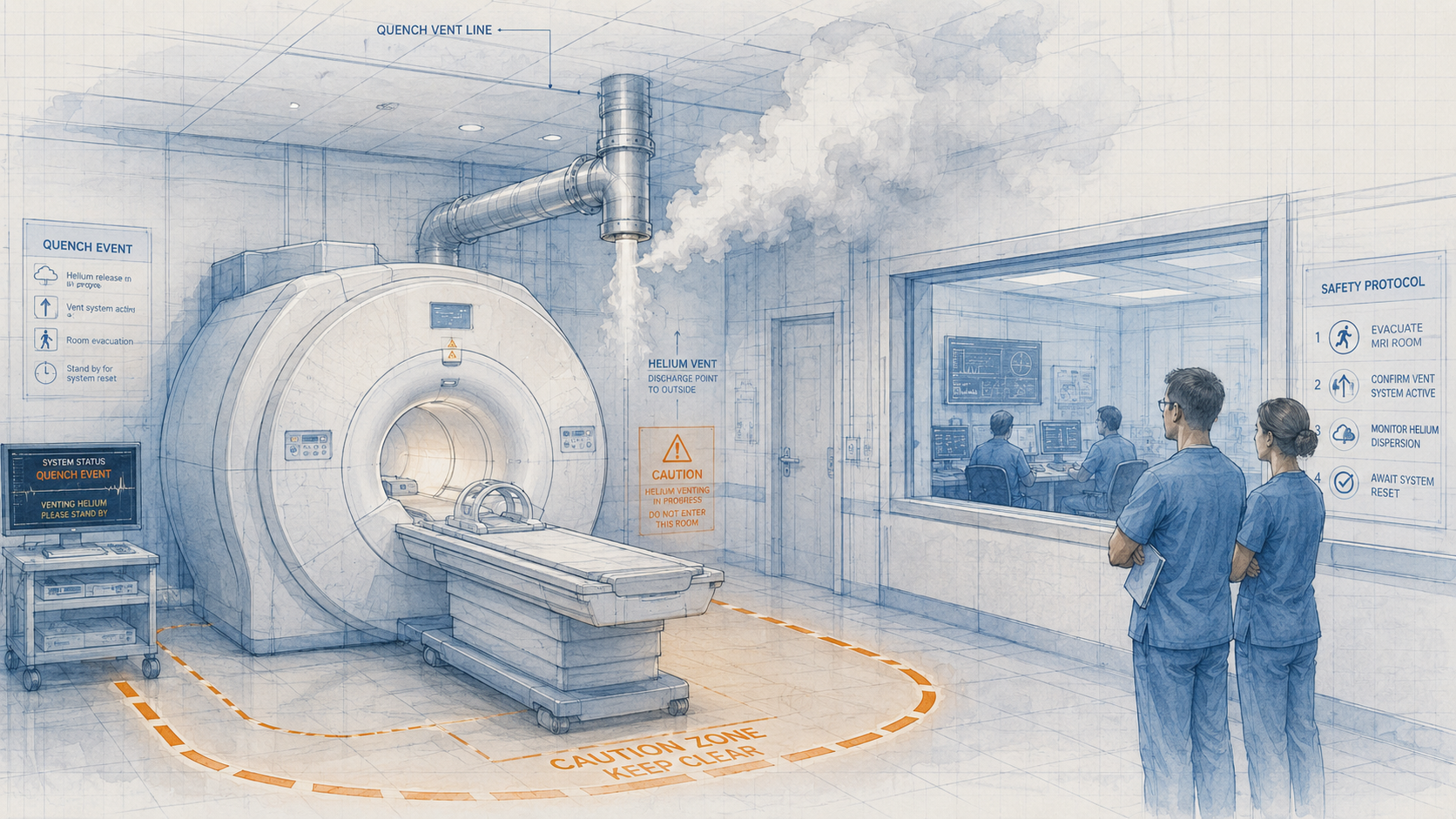
A magnet quench is not merely a mechanical failure. It is a loss of the governed cold state -- the superconducting condition that the entire imaging system depends on. Recovery requires helium supply, specialized service, and time. All three carry cost. None are instantaneous.
| Quench Event Burden | Representative Anchor |
|---|---|
| Direct repair cost -- unplanned quench | At least $80,000 per event (ECRI research) |
| Lost revenue during downtime | Up to $15,000 per day |
| Helium refill cost after quench | $30,000 to $40,000 -- where supply is available |
| MRI idle energy consumption | 9.5 to 14.5 kilowatts continuously; cryogen circulation accounts for approximately one-third of off-mode energy |
Sources: Okon Recycling / ECRI, 2026.
CryoFlux does not replace helium in existing MRI systems. CryoFlux targets the cold continuity infrastructure around the magnet -- the governed supply pathway, loop monitoring, and continuity architecture that reduces exposure to unplanned loss-of-state events.
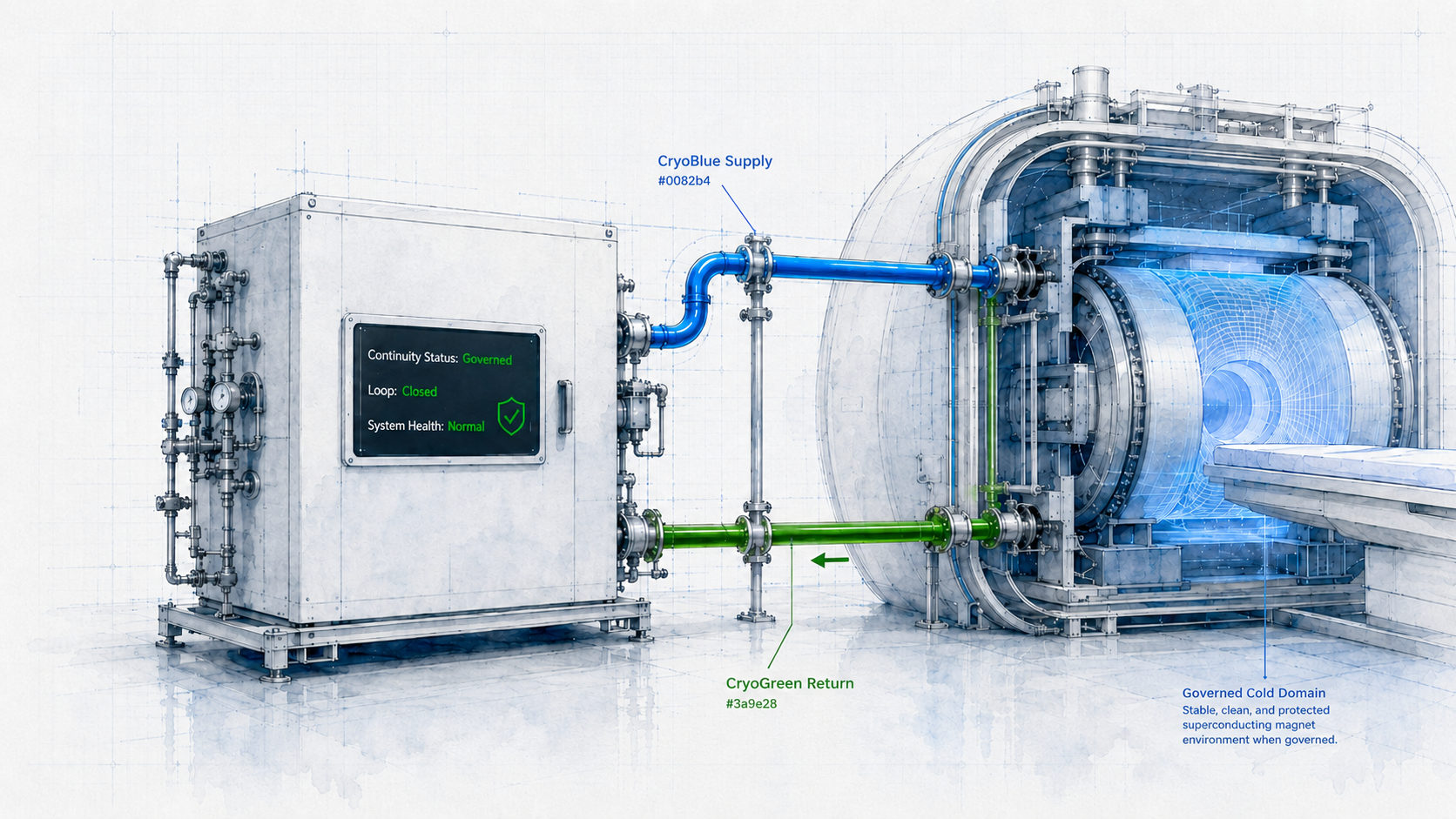
CryoFlux does not operate the MRI magnet. It governs the cold-domain continuity infrastructure that the magnet depends on -- delivering and monitoring the thermal state that keeps the superconducting system in its operating condition.
| CryoFlux Continuity Architecture -- Design Target | Intended Commercial Meaning |
|---|---|
| Governed cold delivery to the superconducting environment | Precision supply of the thermal state the magnet requires -- monitored and governed, not passively maintained |
| Closed-loop return capture | The cold is returned, not discarded -- reducing the dependency on continuous external supply-chain replenishment |
| Continuity state monitoring | Temperature, pressure, flow, return state, and loop health continuously reported -- early-warning architecture for loss-of-state events |
| Supply-chain exposure reduction | Governance of the cold loop reduces the rate of unplanned cryogen loss -- design target, not a guaranteed uptime claim |
| No clinical outcome claims | CryoFlux governs the cold-domain infrastructure. Clinical outcomes are the domain of the imaging system and the clinical team. |
The CryoCycler loop governs the cold-domain energy state around the superconducting system -- delivering the thermal condition, capturing the return, and renewing the cold for reuse rather than discarding it as boil-off loss.
CryoVacuLock / CryoVestibule architecture maintains the atmospheric boundary of the governed cold environment -- controlling moisture ingress and sustaining the pressure conditions that support the superconducting cold domain.
CTD geometry at the thermal interface governs the flow redistribution and contact architecture at the point of cold delivery -- ensuring governed cold reaches the thermal burden source, not just the ambient environment.
| Category | Conventional Cold-Chain Dependency | CryoFlux Governed Continuity Architecture |
|---|---|---|
| Cold-state maintenance | Passive boil-off management with periodic helium refill from external supply chain | Active governed loop -- cold delivered, return captured, loop renewed |
| Supply-chain exposure | Dependent on helium availability, pricing, and delivery lead times -- currently 2-week typical wait after quench | Governed loop reduces unplanned cryogen loss rate -- design target; supply exposure reduced, not eliminated |
| Loss-of-state event cost | At least $80,000 direct repair cost per quench event; up to $15,000/day in lost revenue during downtime | Continuity monitoring and early-warning architecture targets reduction of unplanned loss-of-state events |
| Working medium | Liquid helium -- finite, non-renewable, subject to geopolitical supply disruption and price volatility | LN2-enabled continuity infrastructure -- governed loop, inert working medium, reduced external dependency |
| Monitoring | Periodic manual checks; cold head maintenance on service schedule; no continuous loop telemetry in conventional architecture | Continuous telemetry: temperature, pressure, flow, return state, loop health -- governed state visible in real time |
| Claim posture | Industry standard: helium refill, service contract, quench pipe, periodic maintenance | CryoFlux design intent: governed continuity, not helium replacement. No MRI uptime guarantee. No clinical outcome claim. |
Liquid helium is a finite, non-renewable resource. Every unplanned loss event -- boil-off, quench, service event -- represents both a financial cost and an environmental cost. CryoFlux targets a governed closed loop that reduces unplanned cryogen loss as a design-intent outcome.
Conventional helium supply chains involve extraction, liquefaction, transport, and delivery -- each step carrying an energy and emissions footprint. Governed continuity architecture targets reduced frequency of external supply events by governing the loop rather than relying on periodic refill.
Idle MRI systems consume 9.5 to 14.5 kilowatts continuously, with approximately one-third of off-mode energy attributed to cryogen circulation. CryoFlux targets a more actively governed cold-state architecture that monitors and manages this energy consumption rather than running it passively.
CryoFlux builds the governed cold continuity architecture that protects it.